A colleague (and friend) of mine [(hereafter referred to as Katie Mack the Physics Hack)](https://www.youtube.com/user/thephysicsfactor)
produced a fun video last year that tried to show how people sometimes react when she
tells them that she studies physics:
I loved this video because I've had a number of experiences like this. My
favorite reaction that I've ever gotten happened in 2007. I was on a trip
during college with other college kids, and I was placed in a hotel room with
some guys who went to another school. We met for the first time while
unpacking, and naturally we asked each other what we were studying. Turns out
my new roommate was majoring in international business, something I knew
nothing about. Not wanting to alienate a total stranger I was going to be
sleeping in the same room with, I asked him questions and told him that his
chosen major sounded interesting and important. I told him that I studied
physics, and when he asked me what that meant I told him how I had worked on
modeling [cell division](http://en.wikipedia.org/wiki/Cytokinesis). My new
roommate responded, "You must have a special kind of brain for that."
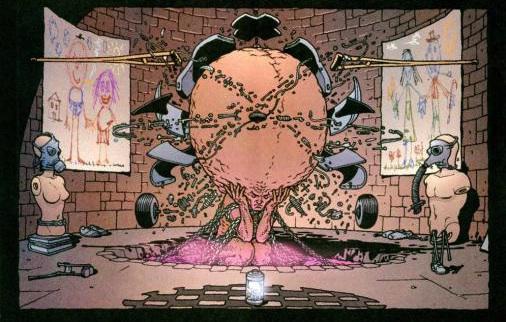
A special brain. [1]
This anecdote has stuck with me for a couple of reasons-- first because
"special kind of brain" is a funny turn of phrase, and second because I think
it's a perfect example of how an attempt at a flattering response can actually
create some uncomfortable social distance between people.
"Special kind of brain" was my roommate's way of expressing how intelligent he
thought I was. (Or, as Zach put it in Katie's video, "You must be soooooo
smart!") His reaction hinged upon the assumption that what I was interested in
doing was so far beyond the understanding of ordinary folk that I could be set
apart as a member of an elite group. Instead of being merely complimentary,
his comment held me at arms' length. His reaction wasn't something I took
offense to, but it made me uncomfortable to hear that he considered me an
outsider of sorts based on my professed interests.
Speaking more generally, the notion that scientific professionals are set apart
from other people as members of a professional group isn't so ridiculous. After
all, these days people's lives are often defined by their careers. (And of
course scientists aren't the only profession with associated negative
stereotypes-- Anyone know any good lawyer jokes?). But to me, thinking of
scientists as some kind of inscrutable cabal of geniuses is an exaggeration.
The truth is, not every scientist is a rocket-powered superbrain. Quite the
opposite-- scientists make silly mistakes all the time. Being a scientist is
a technical profession requiring years of training like law, medicine, or
accounting: there are a few practitioners who really are exceptionally smart,
while most of the others aren't.
The even more disappointing truth is that being a scientist is actually usually
pretty mundane. Don't get me wrong-- the long-term goals of making new
discoveries and developing new insights into the world around us are exactly
why I like my job. I just mean that the day-to-day labor involved can be as
tedious as any other profession. I sit in my cubicle and code (debug)
endlessly on my laptop, or I read books and research papers to learn new things
about my field. Most days don't get much more action-packed than that. In a
lot of ways it's like any other office job. Aside from the end goal of
research, working as a scientist is not so special.
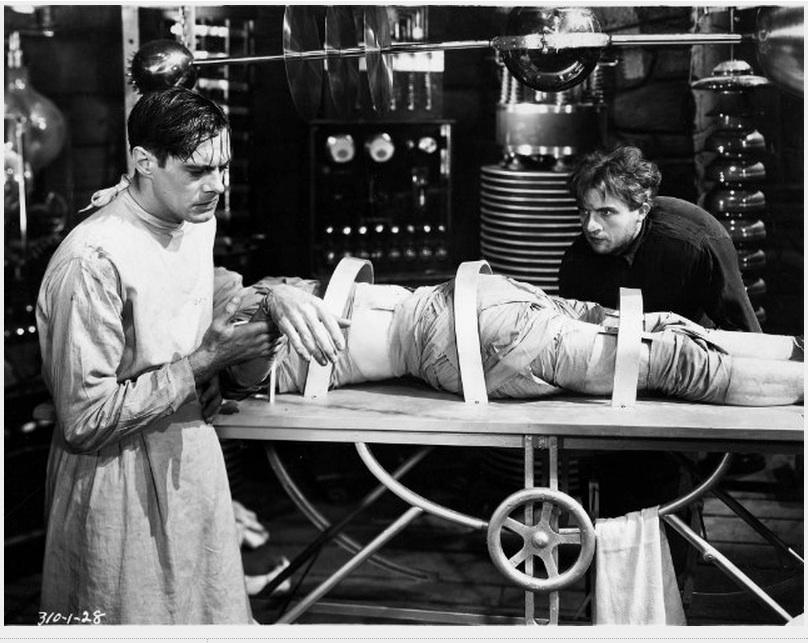
I work in a cubicle. Not here.[2]
Another reaction that I get when I say I study physics is one of apprehensive
disappointment. (Zach's pronunciation of 'ohhhhhh...' combining equal parts
boredom and distaste was dead on.) I don't think I need to dwell on this too
long-- it is undeniably unpleasant for me when I hear this. Upon hearing that
I'm a scientist, otherwise polite, kind people will suddenly lose their cool
and be unable to hide the fact that my profession conjures up memories of
boredom and frustration. ("Oh, man. I HATED physics in high school.") As
Katie Mack puts it at the end, "polite interest is the way to go."
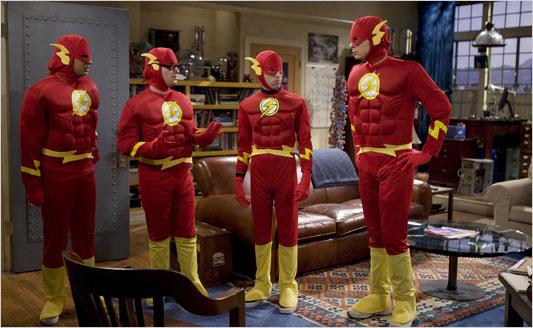
"Have you ever seen the Big Bang Theory?
Is that what physicists are really like?
I bet it is. I mean, no offense."
There's another type of off-putting reaction that comes up sometimes, which is
commenting (jokingly or not) that I'm similar to familiar caricature of
scientists that appear in popular culture. "You're just like Sheldon Cooper!"
is a comment I've heard more times than I care to say. I know that The Big Bang
Theory is a popular show, but frankly I dislike being associated I with
characters that are cartoonishly depicted as condescending and socially
tone-deaf [3]. Now, I appreciate that some
people, when meeting others for the first time, like to demonstrate familiarity
with others' jobs, but to me it just seems that making a pop culture references
to another person's profession is just a bad way to go. I find this to be a
safe bet when meeting anyone, not just scientists, simply because popular
culture isn't a great way to learn about anyone else's job. Try telling the
next lawyer you meet that they remind you of [Saul
Goodman](https://www.youtube.com/watch?v=YPR9ORpwBEU), and see how they react.
So, what is there for physicists (and other scientists) to do when this
happens? The most facile answer to this question is for us to grow a thicker
skin and suck it up. Just ignore it when people have disparaging reactions
upon first meeting us, and find a way to get past this in conversation. The
thing is, I personally am not good enough at hiding my own negative reaction
upon hearing these kinds of obnoxious remarks. Ideally, I'd like to make
conversation easier by finding a way to avoid them altogether.
I can't change the way other people react to learning about my profession, but
I can change how I present myself. Personally, I have given up on telling
people that I'm in the physics department. Instead, when asked "what do you
study in grad school?" I tell then exactly what I'm up to-- I study how
infectious diseases spread through human and animal communities. I've found
that I get a much more relaxed reaction when I do this. The same people who may
have uncomfortable reactions to physics have enough familiarity with the idea
of epidemics to be a little more comfortable. And besides, everyone has some
amount of morbid curiosity about the next big plague that's going to kill us
all. (I realize that this may not be a viable strategy for some of my
colleagues who study nanoscience, magnetic materials, high-energy particles, or
other mainstream physics topics. I'm interested to hear if anyone else who
works in the sciences has come up with a different technique for breaking
through the "I'm a physicist" ice.)
A friend of mine once chastised me for doing this. "Why should you have to hide
what you're interested in?" he asked. "If they react badly to your profession,
is it really worth getting to know them?" To that I say that I'm still telling
them honestly what I'm interested in, I just sidestep the potentially negative
associations carried by the word "physics." And besides, just because someone
has a bad or obnoxious reaction to finding out that I'm a physicist doesn't
mean they aren't worth meeting. The fact remains that I've found this to be a
great way to keep the getting-to-know-you conversation light when meeting new
people for the first time. I wish I could wave a magic wand and make it so that
everyone was comfortable wih the idea of interacting with professional
scientists, but I can't. While I'm waiting for [Bill
Nye](http://www.theverge.com/2014/2/4/5379246/watch-this-bill-nye-debates-evolution-with-the-founder-of-the-creation-museum)
and [Neil DeGrasse Tyson](http://www.cosmosontv.com/) and others to humanize
the profession for the public, this is how I'll be introducing myself.
Katie Mack and Zach's video really got me thinking about how to talk to other
people about their jobs with more empathy-- avoiding flattery and
stereotyping, and doing my best to hide any negative visceral reactions evoked
by the thought of others' jobs and interests. One question that has occurred
to me is whether there are people in completely different professions
experience similarly frustrating reactions when they say what their jobs are.
Programmers, actuaries, office administrators, copy editors, art dealers,
karate instructors, gravediggers, lion-tamers, etc.: whoever you are, I want
to hear about any difficulties you may have had with telling other people what
you do in the comments below.
-
Watch what happens when
a brain surgeon meets a rocket scientist for the first time .
To justify my linking to this skit (outside of the fact that I love it so much),
I'll just say that nobody is acting appropriately in this video.
-
(Sorry, lawyers.)