 [1]
[1]
A friend of mine (I’ll call him Ron), who knows that I study physics,
likes to talk to me about quantum mechanics. He’s an easy-going guy
and likes to joke around. “Hey, is it a particle or is it a wave today?”
he’ll say, or, “How many dimensions do we have now?” When the conversation
turns more serious, he tells me how he believes
in the “quantum universe,” which is greater than what we humans are
able to ordinarily perceive. He talks about consciousness, immortality,
spirits, and the great cosmic grandeur of the universe, all of which he
ties together with the label of “quantum.”
These conversations are strange to me. Both of us are using the same two words:
quantum mechanics. When Ron thinks about quantum mechanics, he associates it
with nonphysical concepts, like spirits. Through my time spent studying physics,
I’ve come to understand quantum mechanics as a theory describing the behavior of
atoms and subatomic particles.
For example, one day our chatting turned to the topic of medicine and how the
human body heals itself. Ron told me that the biggest problem with modern
medicine is that doctors think of the body as a physical object only.
Healing, he said, was a “quantum” effect. I told him that I could make a
pretty strong physical argument for why that wasn’t the case. He responded
with this story: Once, when playing football, he severely injured his knee.
The injury was so bad that he couldn’t bend it or move it. He didn’t have
health insurance and didn’t have the cash on hand to pay for medical treatment.
One day, he prayed to the universe that he would get better and a “tornado of
light came down” and healed his leg. Since then, Ron says, he’s always believed
in and respected the quantum universe.
I can’t tell Ron that what he described in his story didn’t happen,
that his experience was wrong or incorrect in some way. I wasn’t there,
so I can’t comment on the accuracy of his narrative. And even the story
of how his body healed out of the blue isn’t problematic: as far as I can
tell, decades after the story took place, Ron is in good shape and his leg
is doing fine. What I found objectionable about the story was how, in the
end, Ron attributed his healing to the miraculous intervention of quantum mechanics.
Quantum mechanics, in all of its glorious strangeness, is only relevant on
inconceivably small scales and at very, very low temperatures. One of the
reasons it took humans so long to develop the theory of quantum mechanics is
that quantum effects don’t readily appear in everyday life. My [colleagues](http://ultracold.lassp.cornell.edu/)
who work to observe quantum mechanics in their experiments use lasers to manipulate
[atoms](http://en.wikipedia.org/wiki/Rubidium/)
(objects that are 1/10,000,000,000th of a meter in size and weigh around
1/10,000,000,000,000,000,000,000,000th of a kilogram) at temperatures less than
1 Kelvin (about -459 degrees Fahrenheit). At larger sizes and temperatures
quantum effects are negligible. The human body is more than a meter long,
usually weighs around 50-100 kilograms and, if healthy, maintains a toasty
98 degrees Fahrenheit. Quantum mechanics is important at the atomic level,
but on the scales at which people interact with the world it hardly shows up
at all. So, even if Ron's leg heals as he said it did, I wouldn't give credit to quantum mechanics.[2]
I have been studying physics for years and still quantum mechanics
remains utterly baffling to me. The fact that such an abstract theory can tell us so
much about the world feels a little bit like a miracle. Quantum mechanics carries
with it a number of counterintuitive ideas like the
[uncertainty principle](http://opinionator.blogs.nytimes.com/2013/07/21/nothing-to-see-here-demoting-the-uncertainty-principle/)[3]
entanglement, or [parallel universes](http://en.wikipedia.org/wiki/Many-worlds_interpretation).
These ideas are so abstracted from every day life that the subject begins to take
on a supernatural quality. Physics no longer seems like physics-
it starts to sound like mysticism.
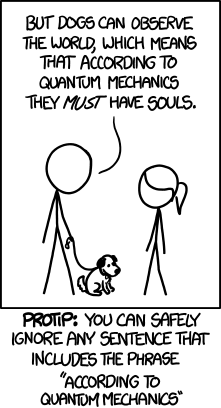
So it makes sense that contemporary culture has seized upon quantum mechanics
as a possible explanation for inexplicable things. The theory has so many
surprising results that it seems natural to extend it to encompass other things
that confuse us, like questions of consciousness. Furthermore, “quantum mechanics”
is a term that carries with it the weight of scientific legitimacy. If Ron had
said that he had been healed through witchcraft, laying on of hands, or alchemy
he would have sounded ridiculous, but attributing his experience to quantum effects
allows the story to borrow from the credible reputation of fact-based 20th century
science. What my friend doesn’t realize is that terminology is not what makes
quantum theory powerful: the scientific methodology supporting quantum mechanics
is what matters.
It’s important to keep separate quantum mechanics the physical theory and
quantum mechanics as a mystical cosmic principle. Despite how confusing it
is, quantum mechanics is an empirically motivated and mature theory that gives
us a framework to understand physical phenomena like radiation and chemical
bonding. This is fundamentally different from applying quantum mechanical
concepts to the nature of reality or consciousness. To do so may be a fun
philosophical parlor game, but it is baseless speculation without any evidence
to motivate the connection between quantum mechanics and the supernatural
that it begins with. This confusion is not just restricted to scientific laymen: there are
trained researchers working at well-respected research institutions
who also [make the same mistake](http://www.quantumconsciousness.org/)
my friend Ron does.
At the end of the day, speculation that the soul, the afterlife, ESP,
or whatever else are quantum effects is unscientific, but at least it
isn’t dangerous or harmful in the same way as climate change denial or
[refusing to vaccinate your children](http://www.nbcnews.com/health/measles-surges-uk-years-after-vaccine-scare-6C9997438/).
It’s closer to something like [intelligent design](http://www.intelligentdesign.org/), which is
[fundamentally confused about what science is](http://en.wikipedia.org/wiki/Kitzmiller_v._Dover_Area_School_District/).
(We physicists are truly thankful that there is no noisy political movement
to teach [Deepak Chopra](https://www.deepakchopra.com/blog/view/900/from_quanta_to_qualia:_the_mystery_of_reality/)
alongside physics in high school classrooms.) So I won’t object to my
friends’ stories of sudden, unexpected recoveries from illness, but
I will react skeptically when I hear that healing has anything to do with quantum mechanics.
-